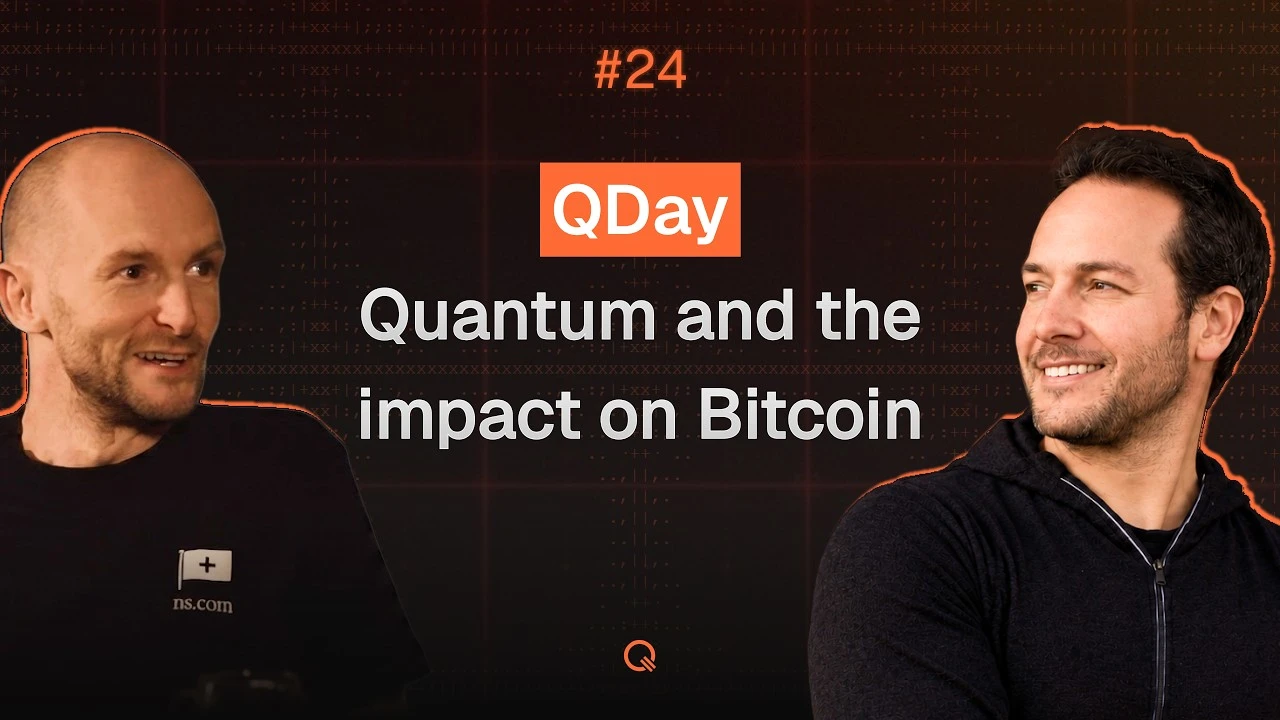
Postquant Labs CEO Colton Dillion joins Chris Smith to discuss how quantum machines differ, what it would take to connect them, and why Bitcoin’s preparation needs to begin before a cryptographic emergency.
This article is an edited summary of Colton Dillion’s appearance on the Quantus podcast, recorded in early September 2026. The conversation has been organized by theme, with quotations lightly edited for readability.
Watch the episode on YouTube. Follow the podcast on Spotify or Apple Podcasts.
Need the transcript for your LLM? Download the full transcript q-day-quantum-and-the-impact-on-bitcoin-transcript.md.
About Colton Dillion
Colton Dillion is the CEO of Postquant Labs, the development company behind Quip Network. He previously co-founded Hedgehog, where he served as CEO and built non-custodial wallets secured by multiparty computation. He was also a co-founder of Gentlemen Labs and Global Director and CMO at Acorns. His work has spanned financial products, crypto wallets and, now, access to quantum computing.
Quote of the episode
“Even if you think this is three years off, five years off, ten years off, you better get started today.”
— Colton Dillion, CEO of Postquant Labs, 26:20
Minute-by-minute episode breakdown
- 01:07: Colton’s route through applied mathematics, engineering, crypto and quantum computing.
- 04:04: Different quantum architectures and the problems they are designed to solve.
- 08:10: Complementarity, measurement and quantum experiments.
- 11:13: Quip’s vision for connecting quantum computers.
- 15:29: Quantum skepticism, hardware limitations and cryptographic risk.
- 24:29: What Colton would do as the hypothetical CEO of Bitcoin.
- 30:06: Available post-quantum algorithms and implementation trade-offs.
- 34:39: The relationship between quantum computing and AI.
- 37:20: Consciousness, reversible computation and the experience of time.
- 44:25: Quip’s roadmap and access for developers.
- 46:19: Quantum game theory, auctions and cooperation.
- 49:28: Colton’s advice for people who want to start learning.
Colton Dillion became interested in applied mathematics after a singing lesson. As a teenager, he asked his coach how he could afford the car he drove. The answer was derivatives trading. He soon began reading about the Black-Scholes model and calculus.
At university, he developed a second interest: designing products for people. His work then included engineering, finance and crypto, including work on wallets. Google’s Willow announcement in late 2024 led him back to quantum computing.
Colton brings those interests to his conversation with Quantus CEO Chris Smith. He wants to make quantum machines useful to more people and is attentive to systems that rely on public-key cryptography vulnerable to a future cryptographically relevant quantum computer.
1. Start with the problem the quantum machine can solve
Early in the episode, Chris asks Colton what different quantum computers are like to work with. He begins by describing their differences.
The word qubit describes a unit of quantum information. Hardware developers use different physical systems to realize it, including trapped ions and superconducting circuits. The machines also differ in how they perform calculations.
He discusses D-Wave’s quantum annealers, which search for low-energy configurations representing candidate solutions to optimization problems. An optimization problem asks for a good arrangement under constraints: a schedule, a route, or a combination of choices. Gate-based quantum computers instead apply sequences of operations to qubits. D-Wave’s documentation explains the annealing approach in more detail.
He uses examples such as finding the fastest or least expensive outcome to explain optimization. There are many possible combinations, and the task is to find one that meets the objective. Whether a particular quantum machine performs that task well has to be tested.
He then describes hybrid computing, where classical and quantum processors work on different parts of a calculation.
“The classical computer does the part it’s good at. The quantum computer does the part it’s good at,” he says at 12:10.
Hybrid computing addresses a constraint he returns to throughout the interview: errors accumulate during quantum computation. Longer calculations become difficult to complete reliably. Classical computers help organize the work and process the results.
He describes a future with better error correction and longer usable computations. For developers working with machines today, the practical sequence is to identify the calculation, understand the hardware, and test whether the quantum approach offers a benefit for that task.
2. Connecting quantum machines creates a problem of trust
Colton’s ambition for Quip includes connecting quantum processors so they can participate in larger computations.
“When we say worldwide quantum computer, we mean that literally,” he says at 14:24.
He argues that connecting machines will be important to increasing useful quantum computation. The connection itself is a major engineering challenge. During the discussion, he allows for a long development period as he describes a future quantum internet.
His ambition depends on capabilities that still have to be built. Accessing separate machines through a shared service and connecting their quantum states are different engineering tasks.
He describes a role for a network that coordinates independent operators. Someone has to make hardware available, accept a program, execute it and return a result. The person requesting the computation needs a way to assess whether the operator did the work correctly.
He asks how a network could detect interference with a calculation and how incentives or penalties could encourage operators to behave as expected.
This creates a crypto coordination problem. A service that coordinates machines owned by different people needs rules for participation.
3. Take the skeptics’ strongest point seriously
When Chris asks Colton to make the strongest case for quantum skepticism, Colton starts with hardware limitations.
“This isn’t going to happen overnight,” Colton says at 15:36.
He describes the difficulty of running long calculations reliably. A device having qubits does not establish that it can complete the operations needed for a useful cryptographic attack. Quantus’s explanation of a cryptographically relevant quantum computer examines that distinction.
He accepts the hardware limits, then points to how quickly quantum capacity compounds. A simulation of 32 fully connected qubits runs on his laptop, he says, while 56 qubits is beyond the largest classical computers. He also argues that preparation takes time, especially for organizations connected to many other organizations. A bank’s upgrade has to work with the institutions and services it depends on. Bitcoin has its own coordination problems.
He also discusses how research changes estimates of the hardware needed for attacks. The Google Quantum AI paper mentioned in the episode estimates the resources needed to derive an elliptic-curve private key from its public key. Its estimates depend on assumptions about hardware speed and error correction. The attack time can also depend on whether part of the calculation is completed before the target public key becomes available.
These are estimates for a specified machine and attack. No such machine has been built yet.
Colton argues that planning must start before the arrival year of a capable machine is known. Designing a migration, reviewing it, and getting people to use it all take time. His concern is that waiting for conclusive evidence of an attack would leave that preparation unfinished.
4. Bitcoin needs a migration people can actually complete
Chris gives Colton a hypothetical job: CEO of Bitcoin. He says he would pay close attention to BIP 360 and the people working on quantum-resistant migration.
BIP 360 remains a draft. It proposes Pay-to-Merkle-Root, a new Bitcoin output type that removes Taproot’s key-path spending option. P2MR removes Taproot’s quantum-vulnerable key-path spend by omitting the internal key and its tweak step. Keys inside a script can still be revealed when that script is spent. Protecting against attacks on keys revealed during spending would require additional measures, such as post-quantum signatures.
Colton then describes a scenario in which coins associated with Satoshi move and someone claims to be their owner. He asks how quickly people would recognize a possible quantum attack, and whether the event would produce agreement about what to do.
Agreement would only begin the work of moving funds.
If an attacker could derive private keys, proving legitimate ownership would become harder. Colton discusses whether a holder could instead prove knowledge of a wallet’s seed without revealing it. The seed is the recovery secret from which the wallet’s keys can be derived.
Chris notes a limit. In Bitcoin, the technique works for wallets whose keys were derived from a seed, known as hierarchical deterministic (HD) wallets. That covers “probably most people, but not all,” he says, which adds a political challenge to any migration decision.
Completing a migration would also require onchain transactions, and those transactions would have to fit within Bitcoin’s block capacity. Colton estimates the process would take “months and months and months of blocks.” He warns about the pressure that a rush to move vulnerable funds would create, particularly if Bitcoin’s community were still implementing the new rules.
Their exchange raises three concrete questions for a migration plan:
| Part of the migration | Question the discussion raises |
|---|---|
| Ownership | Question the discussion raisesHow can a legitimate holder prove control under the new rules? |
| Capacity | Question the discussion raisesHow many holders can complete the required transactions, and over what period? |
| Coverage | Question the discussion raisesWhich existing wallets and coins can use the proposed method? |
Colton also recognizes that choosing post-quantum cryptography involves practical trade-offs. Existing options differ in signature size, speed and operational requirements. Quip chose SPHINCS+, a hash-based signature scheme, because a quantum-compute network cannot itself be vulnerable to quantum computers. SPHINCS+ signatures are large, so his team built a variant that uses much less space for most transactions.
“There are algorithms that exist today that you can use. They’re off the shelf,” he says at 30:08.
Developers still need to decide which approach suits a network, test its implementation, and work out how existing users will adopt it.
5. Quantum AI depends on the machines we can build
Chris next asks why quantum computing and AI are so often discussed together. Colton sees opportunities across machine learning, including preparing data, training and optimization.
He adds a condition at 36:31: “assuming that you have a large enough quantum computer.”
He acknowledges the gap between the quantum hardware he is discussing and the scale of modern AI workloads. Large models require enormous amounts of computation and memory. Applying quantum methods at that scale would depend on progress in both hardware and algorithms.
Research on quantum machine learning asks more specific questions. A Google Research study, for example, examines how the available data affects whether a quantum learning method has an advantage over classical methods. The task and data matter alongside the processor.
The practical test is to identify the part of the work a quantum method improves and compare it with the available classical approaches.
The conversation then becomes more speculative. Chris asks about consciousness and whether the brain should be understood as a quantum computer. Colton answers that classical AI already reproduces a great deal of logic without quantum phenomena, so quantum effects may not be necessary for reasoning.
They then explore reversible computation, time and different ways of perceiving reality. Colton calls his view on those questions “personal metaphysics.” Their discussion remains exploratory, considering how different forms of intelligence might perceive and organize information.
6. Make quantum computing something people can use
When Chris asks about Quip’s roadmap, Colton describes plans for software and participation.
At the time of the recording, he says people could run a node to validate outputs from D-Wave computers on the network. His roadmap includes adding gate-based platforms and releasing a virtual machine through which developers could deploy programs that others could request to run.
“We hope that we can do for quantum computing what open source has done for classical computing,” he says at 45:21.
He describes a model in which developers could build on one another’s programs and earn money when those programs are used. Hardware operators would gain users, while people without detailed knowledge of quantum machines could access useful applications.
The roadmap also depends on product design. He describes operators who want more people to use their hardware and potential users who find the machines difficult to approach. Reusable programs would make it easier for those users to try the machines.
He also discusses quantum game theory, including possible auction and cooperation mechanisms.
The closing exchange returns to participation. Quantum computing has a reputation for being inaccessible even to very capable people. Colton says unanswered questions should encourage experimentation.
“There are a lot of things we don’t understand. That shouldn’t stop you from playing with it,” he says at 49:00.
For readers who already use matrices, vectors or arrays, some of the mathematics may feel familiar. For everyone else, his advice is to find people who understand the subject, ask questions, and try things.
Related resources
- Quip Network: The project discussed throughout the episode.
- BIP 360: Pay-to-Merkle-Root: The Bitcoin proposal Colton recommends following.
- Google Quantum AI’s cryptocurrency research: Resource estimates and mitigation strategies for quantum attacks on elliptic-curve cryptocurrencies.
- What Is a CRQC?: What makes a quantum computer capable of a useful cryptographic attack.
- What Is Q-Day?: How quantum capability, exposure and migration affect crypto security.