In brief
- Ten contributors from nine organizations launched the Quantum Alliance, an open standards body, on October 15, 2026.
- Its first job is a public definition of quantum readiness for blockchains, with tests any team can run on its own code.
- Four working groups cover moving live chains to new cryptography, quantum-resistant zero-knowledge proofs, wallet security, and cross-chain compatibility.
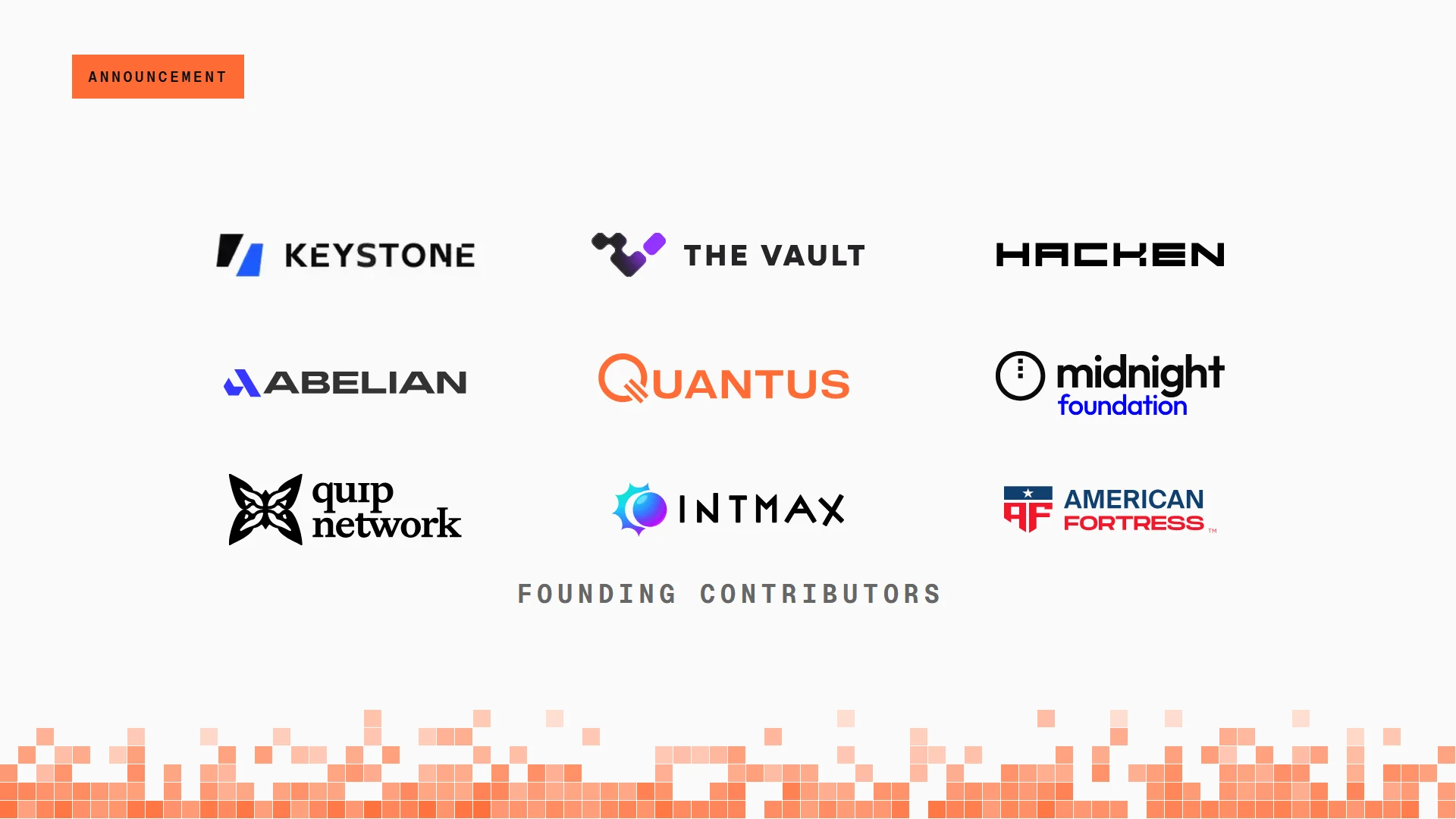
Quantus founder and CEO Christopher Smith is one of the Alliance’s ten founding contributors. The Alliance will define what it means for a blockchain, wallet, or piece of infrastructure to be ready for quantum computers.
Quantum estimates are falling, and readiness is still undefined
Most major blockchains authorize transactions with elliptic-curve signatures. A sufficiently capable quantum computer could derive a private key from an exposed public key. This year, a new estimate, an expert forecast, and a hardware result all point the same way.
In March, Google Quantum AI published an estimate with researchers from the Ethereum Foundation and Stanford. Breaking the elliptic-curve cryptography behind Bitcoin and Ethereum could need fewer than 500,000 physical qubits on superconducting hardware, about a twentieth of a 2023 estimate.
In April, the computer scientist Scott Aaronson wrote that hardware experts he trusts now expect a machine able to break deployed cryptosystems around 2029. He asked readers to “urge your company or organization or blockchain or standards body” to start switching.
On October 19, Quantinuum reported a logical fidelity of 99.9995% on its Helios computer, about five errors per million operations. Error rates are the main obstacle to building that machine. The company said its accuracy is now within the target range for Apollo, the fault-tolerant machine it expects to deliver by 2029. No existing machine can break elliptic-curve keys yet.
The replacement cryptography already exists. The U.S. National Institute of Standards and Technology (NIST) finalized its first post-quantum standards in August 2024. The open question is what counts as using them. A chain can upgrade its transaction signatures while its consensus, key management, or proof systems still rely on elliptic curves. Today there is no shared test that separates a partial upgrade from a chain that is ready.
What the Alliance will do
The Alliance’s process is modeled on the Internet Engineering Task Force. Participation is open to individual contributors, and proposals advance on public evidence, working implementations, and rough consensus. Serious technical objections must be considered and answered, even when the final proposal does not accommodate them. Company size and token holdings add no voting weight.
The first deliverable is a public definition of quantum readiness covering five areas: transaction signatures, key management, consensus, zero-knowledge proof systems, and peer-to-peer connections. The Alliance also plans to publish open test criteria, benchmarks, and reference designs for migration, so any project can adopt the standards and test its own claims.
Four working groups
Migration: How a live chain moves funds and keys to post-quantum schemes, including accounts whose public keys are already exposed on-chain and coins whose owners can no longer move them. The group will also examine how chains accommodate the larger transactions that post-quantum signatures produce.
Post-quantum zero-knowledge systems: Many privacy networks, zero-knowledge rollups, and cross-chain tools rely on proof systems built on elliptic curves. Hash-based designs such as zk-STARKs avoid that dependence but produce larger proofs, so teams have to weigh proof size against speed and security level.
“Agreeing on how to evaluate post-quantum proof systems now saves every team from solving it alone later,” said Sebastien Guillemot, CTO of Midnight Foundation.
Wallet security: How users and custodians generate, store, and sign with post-quantum keys, from hardware secure elements to recovery flows. The group builds on Wallet Security for Post-Quantum Ethereum, a proposal co-authored by Dr. Richard T. Carback III of Postquant Labs.
“Hardware wallets sit at the point where new cryptography meets real users,” said Aaron Chen, CTO of Keystone.
Cross-chain compatibility: This group will develop shared specifications for wallets, bridges, and hardware signers to handle post-quantum keys consistently across chains.
The founding contributors
- Christopher Smith, founder and CEO of Quantus
- Michal “Mehow” Pospieszalski, CEO of American Fortress
- Leona Hioki, co-founder of Intmax
- Aaron Chen, CTO of Keystone
- Sebastien Guillemot, CTO of Midnight Foundation
- Colton Dillion, co-founder and CEO of Postquant Labs, which develops Quip Network
- Dr. Richard T. Carback III, co-founder and CTO of Postquant Labs
- Richard Lee, Chief Business Officer of Abelian
- Bryn Bennett, Chief Revenue Officer of The Vault
- Katina Messinis, Head of Business Development at Hacken
Where Quantus fits
Quantus has run on post-quantum cryptography since its first block. Here is how its design maps to the five areas the Alliance’s definition will cover.
| Area | Common elliptic-curve design | Quantus |
|---|---|---|
| Transaction signatures | Common elliptic-curve designECDSA, Schnorr, or EdDSA | QuantusML-DSA (NIST FIPS 204). ML-DSA-65 by default, ML-DSA-87 available |
| Key management | Common elliptic-curve designElliptic-curve wallet keys | QuantusML-DSA keys derived in a hierarchical deterministic (HD) wallet. Implementation audited by Neodyme |
| Consensus | Common elliptic-curve designProof-of-stake chains: validator signatures on elliptic curves | QuantusProof of work using Poseidon2 hashing, with no signatures needed to produce blocks |
| Zero-knowledge proofs | Common elliptic-curve designWhere used, often pairing-based systems on elliptic curves | QuantusPlonky2, a hash-based proof system with no trusted setup. Quantus Wormhole uses it for unlinkable transfers and proof aggregation |
| Peer-to-peer connections | Common elliptic-curve designElliptic-curve key exchange where traffic is encrypted, and elliptic-curve node identity keys | QuantusML-KEM-768 key exchange (NIST FIPS 203) and ML-DSA-87 node identity |
Full details are in the Quantus whitepaper.
“In the future, ‘post-quantum cryptography’ will just be called ‘cryptography’ and everything else will be in a museum. Our intention with the Quantum Alliance is to front-load a lot of the complex decision-making when making post-quantum blockchain products and create standards that others can simply pull off the shelf as the industry migrates,” said Chris Smith, founder and CEO of Quantus.